Online Groups: Sort Out the Nonsense How to Sift Through the Answers and Motives of Online Q&A’s Prior to the rise of the powerful internet and social media, information was exchanged and shared in person, in local establishments amongst patrons and through traditional media channels …
From Summerbird to Snowbird Transition from a Summer to Winter Stay in Your Warm Weather Community Many times I’m inspired to write about questions I receive seeking insight of the snowbird life. This time our repeat vacation rental guests asked about making the transition from …
How to Get to Your Warm Weather Destination Without Driving Yourself
At some point, every snowbird must decide whether to continue driving themselves to their destination. It's a tough decision snowbirds face for various reasons.
As snowbirds age, it becomes increasingly challenging to navigate traffic and long distances to get to and from one's destination. I typically assist my husband with routes and traffic as we travel through Indianapolis, Indiana; Louisville, Kentucky; Nashville, Tennessee; then Birmingham and Montgomery, Alabama. Our snowbird friends from Minnesota, Wisconsin, Colorado and Ohio must endure longer distances including traversing metro areas such as Chicago, Illinois; St Louis, Missouri, Memphis Tennessee and Atlanta, Georgia.
Add hills and mountains, poor weather conditions, traffic accidents, road construction, low lighting due to nighttime travel and you get a potentially treacherous mix. None of this is particularly easy when in your 50's and 60's and it feels that much more distressing in your 70's, 80's and 90's. Fatigue is a problem at any age, but it only gets worse when combined with declining health, limited vision and/or solo travelers who don't have anyone with whom to trade driving duty. Safety is always a concern when traveling, especially when solo or elderly.
I spoke with several friends who are all facing the dilemma of what to do about travel alternatives. Two are solo women and one couple will be 80 and 90 years old by next season. After much thought and discussion, these are the pros and cons for alternate travel options for snowbirds who no longer want to continue driving to their warm weather destinations.
Two Travel Options When You No Longer Want to Drive to Your Snowbird Destination
Air Travel
Not everyone is a good candidate for air travel, but for those who can make it work, go for it! Bus or train travel has similar considerations to air travel and may or may not be a good option for snowbirds.
Pros:
Eliminates the need to drive to your destination; is typically faster than driving; can potentially accommodate some pets; usually eliminates the need for hotels to/from your destination.
Cons:
Weather travel delays; need to rent a vehicle OR store a vehicle in the off-season; proximity to/from the airport may require a long drive; a shuttle or transportation to from/airport is required; air travel may or may not work for all pets; air, bus or train travel may not work well for all humans; shipping belongings may be necessary; flights can be expensive and not flexible for travel dates
Hire a Driver or Enlist the Assistance of Family/Friends to Drive
As with any other mode of travel, enlisting the assistance of family or a professional driver is not without advantages and drawbacks.
Pros:
Provides bonding time with a friend or family member; accommodates most pets and there may be some flexibility with travel dates depending on the driver who will be assisting you.
Cons:
Must rely on the schedule of others; professional drivers will charge a fee; must trust the driving skills of someone else; driver/s must travel to your area for pick-up and drop off; compatibility during travel could be an issue; it does not eliminate the need for hotels to/from your destination and possibly requires a second room for your driver/s; requires paying for meals and incidentals for your driver; airfare to/from your destination for your driver is necessary and you will need to rent a vehicle OR store one on site in the off-season.
"I can't change the direction of the wind, but I can adjust my sails to always reach my destination.”
-- Jimmy Dean, American country music singer, actor, businessman
The information contained in this website is for general information purposes only. We make no representations or warranties of any kind, express or implied, about the completeness, accuracy, reliability, suitability or availability with respect to the website or the information, products, services, or related graphics contained on the website for any purpose. Any reliance you place on such information is therefore strictly at your own risk.
In no event will we be liable for any loss or damage including without limitation, indirect or consequential loss or damage, or any loss or damage whatsoever arising from or in connection with, the use of this website.
Through this website you are able to link to other websites which are not under the control of Midlife Snowbird. We have no control over the nature, content and availability of those sites. The inclusion of any links or advertisements does not necessarily imply a recommendation or endorse the views expressed within them.
Stinky’s Fish Camp, Santa Rosa Beach, Florida Starter Snowbirds An Analysis of Two Pre-Emerging Snowbird Couples While sitting around a firepit at our neighbor’s end of summer social gathering, the topic of retirement and possibly becoming a snowbird were of interest to two couples who …
Where to Shop Where to shop to furnish your vacation rental or second home Personally, I’m not a shopper. I’d rather do almost anything else than run to the store for something. Professionally, I’ve become adept at finding everything needed to furnish our vacation rental …
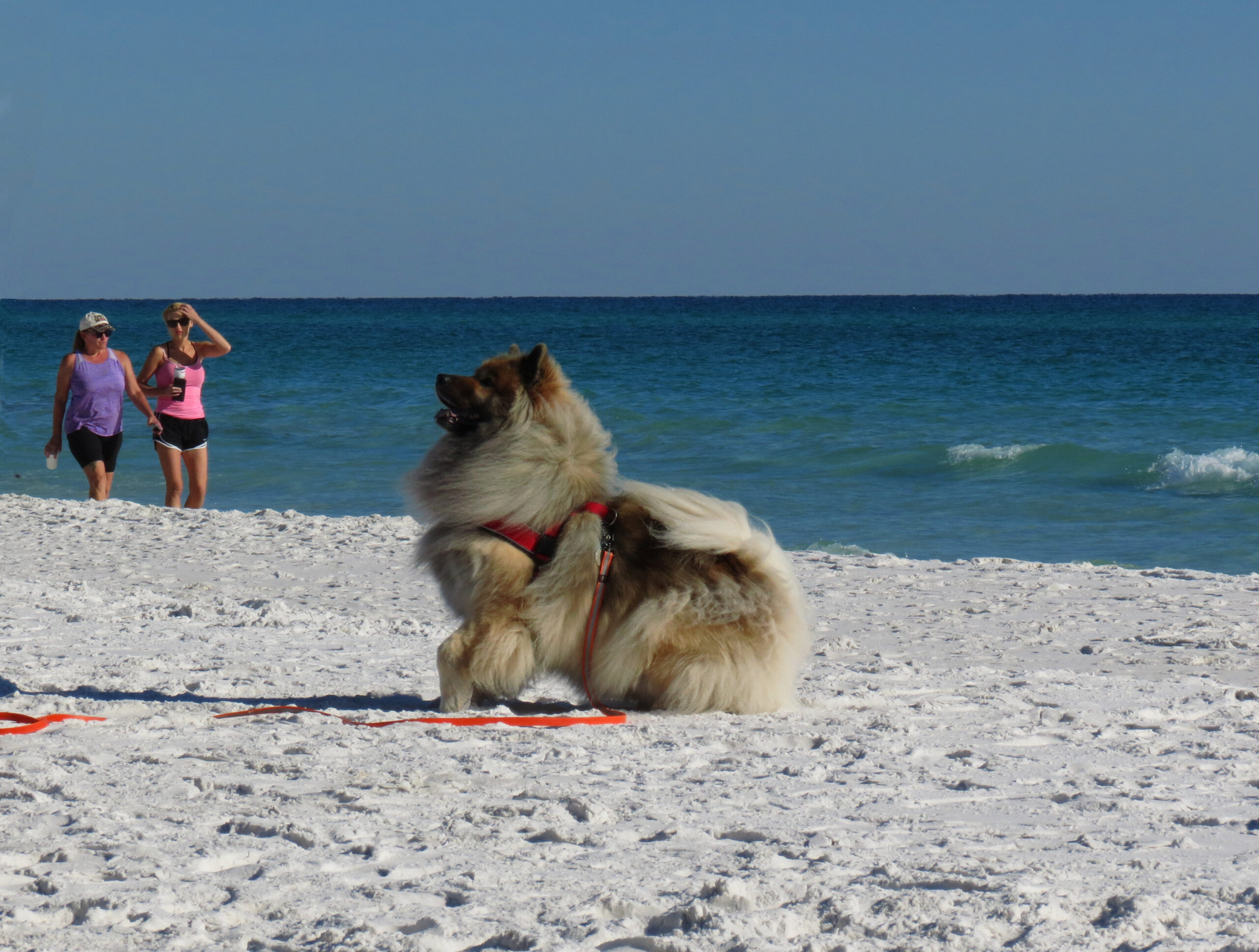
Cosmo is an international flying snowdog who lives in Germany and has made seven round trips to NW Florida since he was a pup
Flying Snowbirds
Are you a good candidate to fly to your warm weather destination?
Flying snowbirds are a bit of an enigma because they are much smaller in numbers around our snowbird community. However, small in numbers or not, there are basic considerations for future flying snowbirds. In many ways it seems like a great idea, but it's not without drawbacks too, which is probably why flying snowbirds are not the majority in my warm weather community. Snowbirds in the Hawaiian islands are a unique situation because everybody must fly there.
Below I will share the personal story of a special lady I met on the beach. She is inspiring for her independence as a solo snowbird who annually flies to her destination despite her health and financial challenges. Patti's story is both heartbreaking and heartwarming, which is why I feel compelled to share it. If you have personal experience as a flying snowbird, please reach out. I want to hear from you.
Are you a good candidate to fly to your warm weather destination?
Be completely honest and answer these questions for yourself and any travel companion/s, spouse, partner and pet.
Are you healthy enough to fly? If you require special assistance due to health issues, mobility and more, it's important to address it before going further with your plans.
Do you have recent experience with air travel? Not from five or ten+ years ago, things have changed a lot in the last few years.
Can you successfully navigate through the airport terminal/s and make any necessary connections for each leg of your journey?
Do you have enough physical stamina to fly? It's a very long process, is usually exhausting and that's if all goes to plan with no delays.
Can you comfortably fit into the seat? Seats are much smaller and tighter than in the past unless upgrading if it's available.
Are you able to adequately move from the front of the cabin to the back of the plane where the lavatory is located?
Do you have a pet that will be flying with you? Large pets must fly in cargo and all pets must pay fees and provide health certificates.
Can your pet realistically endure the duration of the trip mentally and physically? Be fair and know it's hard on them due to separation and added stress.
Are you able to pare down your necessary possessions to travel by air for an extended time away?
Does the price of the airfare fit into your budget? Check current airfare rates and prepare for sticker shock.
Do you have an effective plan to get to/from the airport in each of your communities? No one wants to park their vehicle at the airport for weeks or months at a time.
How will you get to your final destination? Is someone or a service available to pick you up?
What mode of transportation will you use for the duration of your stay in your snowbird community? Walk? Rent a vehicle or bike?
Do you have a contingency plan in the event of unforeseen travel delays? Weather, mechanical, work strikes and other unanticipated events may cause delays or cancelled flights.
If you are flying internationally, do you have all of the proper paperwork, current passport/s and other documentation?
Are you OK with less flexibility for changing flights? Some airlines only fly on certain days of the week and/or sell out their flights during peak dates.
Logistics, Logistics, Logistics
Snowbirds by nature must be very organized and savvy about what to pack or not. Flying snowbirds take it to the next level. There's three options for snowbirds who do not own a place in their warm weather climate: pare it all down to a couple of suitcases; ship boxes to/from your destination or store it locally when not there.
Renting space in a self-storage unit can work for repeat flying snowbirds. The keyword here is repeat. It is a challenge to make sure you can come back each year and get your things out of storage if you no longer plan or are able to return. Many snowbirds want to return only to endure unexpected health, financial, family or other problems. If a flying snowbird must become a road trip snowbird to retrieve their possessions, it can be an expensive financial and/or personal challenge.
Beware of accumulating too much stuff in your storage unit as well as the expense of a monthly unit. It is not by any means "cheap." Think it over before you decide if it's that important to you. If your annual cost of a storage unit is $1,000, are your stored items worth it?
Snowbirds who have their own place can certainly leave things behind and not have to bring it back and forth. When I say "leave things behind" that could also include a vehicle. However, if the vehicle will be parked outside, it can become damaged from weather or other trauma. Any vehicle that isn't driven for weeks or months at a time is very likely to require maintenance when you return.
I know of two couples in their early sixties who selected Hawaii as their desired winter home. They have no other choice than to fly there from the Midwest. After a few years, one couple stopped going due to the expense plus distance and bought a condo in the Punta Gorda area of South Florida. The other couple stays in Maui with her daughter and grandchildren for four or five months at a time. They bought a vehicle to use while there and leave it behind the rest of the year.
Flying international snowbirds come to the US for various reasons. One neighborhood couple is based in Germany with their dog, Cosmo, who flies to NW Florida in the cargo section of the plane. They met and married during his military career and now they spend extended time in Florida and Texas to visit his American family every season. Heidi said Cosmo does OK with cargo travel, he has made seven round trips since they adopted him as a puppy, but it's a major consideration for dog owners who fly.
Check Travel Rates and Dates
One huge disadvantage of being a flying snowbird is the loss of flexibility. The cost of airfare, fees and availability are at the discretion of the airlines. The best of carefully made plans can be upended in a matter of hours due to weather delays and cancellations. Direct flights are the best option for many travelers, but during the winter, many airlines reduce their direct flights because they aren't as popular as peak vacation season. If your departure city is not a major hub, you may have one or two connecting flights and layovers. This adds to stress, especially if there are delays.
Other airlines only offer flights on certain days of the week, which can create a domino effect for snowbirds who don't have flexibility to check in early or check out later than their booked dates.
Airfare rates during the holidays are always higher and snowbirds who return home during Spring Break can expect to pay more and that's if there's any seats available.
Air travel has become quite expensive. If you haven't priced tickets lately, take a look, the fees may surprise you.
Future Flying Snowbirds
My in-laws purchased a place in South Florida about two years ago. They have a medium sized older dog and are able to drive to/from NW Ohio. However, they realize at some point they will become flying snowbirds because of the distance from their primary home. When the time comes, if they have another dog it will need to be small enough to travel in the cabin with them. They'll also need to work out all of the logistical concerns of being flying snowbirds because "traveling light" is not exactly their current motto.
One of the biggest factors when choosing a snowbird community is how much it will cost and how will you get there. South Florida generally has warmer weather than Northern Florida, but the trade off is that comes at a higher expense as well as additional travel time. [Location, Location, Location: Peak Vs Off Peak]
Road trip snowbirds who become flying snowbirds will have adjustments and trade-offs to make. Our former Northern neighbors discovered exactly what this means when they transitioned. They fly direct on a budget airline to the Sanford, Florida airport near Orlando. However, they still have to make transportation arrangements to get themselves and their luggage to their park model home that's located about an hour's drive south of the airport. Let's face it, one of the main reasons my former neighbors became flying snowbirds is due to their age. Now they are relying on their snowbird community neighbors to be able to navigate Orlando traffic. It is an imposition on whoever the designated driver is and Dave and Diana have to organize their flights to work with their own schedule as well as the driver. At some point, a professional driver may be the best choice for their needs.
Patti's Heartwarming and Heartbreaking Story
One evening I was walking solo on the beach, taking photos of the sunset. Another nearby woman was also doing the same thing and we ended up walking and talking together. During the conversation we realized we were both staying at the same condo complex. The lady told me her name is "P - a - t - t - i -- Patty with an i." Right away I noticed she was different due to her speech, her physical features and she had an unusual gait. She walked with a laborious slant to one side and her brimmed bucket-style fishing hat was pulled kind of low. It partially hid her muscle disfigurements of her face and eyes.
Patti told me she is 67 years old, lives in Minneapolis and has been a solo snowbird for six years. She said she never married and has several great nephews and two cats at home. Patti explained she "walks all day" because she stopped driving 21 years ago. Patti had a stroke at the age of 45 and was diagnosed with Multiple Sclerosis at that time, also known as MS. She said she's probably had MS since her teen years and didn't realize it until the stroke.
Patti loves her snowbird lifestyle so much that she said "saves all of her money" from her $1,500 a month retirement and disability income so she can travel to the beach. Because Patti comes from Minnesota, she always buys trip insurance from the airline. One season her flights and accommodations became out of sync and she ended up departing Florida five days after she had to check out of her rental, so she stayed at an Extended Stay hotel. The change fee from her trip insurance covered the cost of one of the hotel nights. Patti's taxi fee from the airport to the beach is around $75 each way and if she needs to go anywhere during her time away, she pays for an Uber driver. She relies on deliveries as much as possible.
Patti confided she has a social phobia, but in her adopted southern community, "Everyone is so nice to her" and it eases her phobia. The beach truly does bring people together. As we said goodbye, we agreed we hoped we would see each other again. I went upstairs to write down Patti's story and reflect on how blessed I am. Thinking about Patti makes me teary, her story is heartbreaking. I can't imagine what she has to deal with every day just to get her essentials for daily living and yet she makes it work. I felt the 20 minutes I spent with Patti were especially inspirational and heartwarming because of her bravery to make a dream happen every year: to be a snowbird who just happens to fly.
The information contained in this website is for general information purposes only. We make no representations or warranties of any kind, express or implied, about the completeness, accuracy, reliability, suitability or availability with respect to the website or the information, products, services, or related graphics contained on the website for any purpose. Any reliance you place on such information is therefore strictly at your own risk.
In no event will we be liable for any loss or damage including without limitation, indirect or consequential loss or damage, or any loss or damage whatsoever arising from or in connection with, the use of this website.
Through this website you are able to link to other websites which are not under the control of Midlife Snowbird. We have no control over the nature, content and availability of those sites. The inclusion of any links or advertisements does not necessarily imply a recommendation or endorse the views expressed within them.
Our first year as snowbirds, we witnessed a raging fire that broke out at AJ’s where we had just departed just seconds earlier Nothing Bad Ever Happens at the Beach Why Snowbirds and Tourists Should Know and Set Individual Limits For nine years and counting, …
The Covid-19 pandemic has forced a re-evaluation of metro vs. smaller populations for snowbirds and Zoombirds [Natchez Street, Seaside Florida] Snowbird Destination Trends Considerations for Snowbirds and Zoombirds What are the latest snowbird destination trends? I was recently interviewed for an article, “Boca Raton, Florida, …
Prior to unloading anything, take extra precautions to sanitize the air and surfaces of your hotel room while in transit to your destination
Snowbird Travel Precautions During A Pandemic
Guidelines to Consider Prior to Your Road Trip
Many snowbirds depart for their southern homes after the December holidays at the start of the new year, including my husband and I. However, 2020's historical Covid-19 pandemic has created even more reasons than ever to be smarter about when, where and if travel is necessary at this time. By now, there's been plenty of travel warnings and advisories issued from renowned health care experts, world governments and global health organizations.
First and foremost, above all else, anyone who is ill should stay home until fully recovered. Those at higher risk with health problems or who have other underlying conditions should weigh all options and consult with their own personal medical team. Snowbirds who have made the decision to travel should consider the advice of the experts and take the highest precautions to avoid becoming sick. Masks, social distancing and diligent sanitizing remain the top criteria for reducing risks of exposure; however, there is much more, especially when travelling.
Below are common sense guidelines for travelers driving to their destination with a hotel stay along the way based on my long-time personal experience. I have always been super cautious about germs, so it wasn't that much of an adjustment to step up to even higher levels of caution. During this past summer, my husband, dog and I went on two mini overnight getaways within an hour of our home and it helped us prep for the long haul to our warm weather home. We learned a few things that helped us improve our systems. Because of our short summer travel, we gained increased confidence that it can be done with proper precautions.
Taking meticulous measures and constantly being alert and pro-active are traits I have employed long before there was a global pandemic. It is well worth the effort if it can improve the chances of getting to your destination safely and without becoming sick after arriving. These guidelines are in no way intended to be construed as anything other than general information. Do your own research, follow all local and state mandates, as well as other government agencies.
Checklist of General Travel Considerations
Many snowbirds have pre-paid for their non-refundable rental residences and may have other commitments and obligations in their southern communities. Of course, the reasons for migrating to warmer climates is to get out of the frigid temperatures, rejuvenate one's outlook and be able to spend time outdoors. Thus, cancelling the trip is not anyone's first choice if they can help it.
If your hotel has a breakfast buffet, choose individually wrapped items and fruits that can be peeled. Take your food to eat in your room instead of a public dining area.
Finding ways to reduce risk and improve precautions is a smart way to prepare for the journey. There is no way possible to eliminate all risk, so travel at your own discretion.
Check in advance with your hotel regarding specific procedures they follow regarding extra cleaning and sanitation precautions. Ask if contactless check-in is available. You may want to also inquire about whether "free breakfast" and/or onsite restaurant services will be reduced or unavailable as well as amenities such as swimming pools, fitness centers, business centers and so forth.
I never thought I'd say this, but hotel rooms with (typically noisy) in-room heating and air conditioning units are preferred compared to hotel rooms with central HVAC systems. Our highway hotel fills this need, along with windows that can be opened for additional outside air. Motels with rooms that can be individually accessed via a private exterior door are also better options during a pandemic.
If travelling with anyone outside of your immediate household, do not share a hotel room or ride in the same vehicle if at all possible. If there's no other options, each household should try to self-isolate for 14 days prior to travelling together.
I've separated the travel considerations below into pre-planning/prep, in-transit and hotel guidelines. Upon arrival at your destination, follow the same procedures as when checking into your hotel. Always, always (pandemic or not) run every single utensil, plate, glass, dish and pan through the dishwasher with soap to sterilize them prior to first use. Never assume the dishes are sterile just because they look "clean," they may have only been rinsed or worse, just placed in the cupboard as the previous guest vacated the property.
PRE-PLANNING/PREP
1. Take inventory and Purchase All Necessary Sanitation Products, Including the Following:
--Masks or facial coverings for each person, plus several back-ups
--Hand sanitizer: bottle with cap or pump style
--Hand sanitizer: packets
--Hand sanitizer: travel size for purse or bag
--Towelette style sanitizers in a plastic container with lid
--Rubber gloves, disposable
--Spray sanitizers such as Lysol® Disinfectant Spray
--Paper towels
***Read the labels before using to ensure you don't damage any hard surfaces with your sanitation products***
2. Organize your sanitation supplies
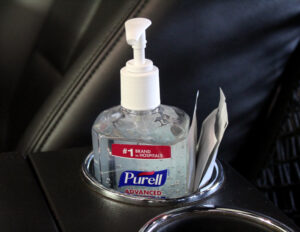
Place pump-style hand sanitizer within easy reach in the drink holder of your vehicle along with packets of alcohol wipes
--Place hand sanitizer in your vehicle's drink holders, glove box and anywhere else that is within easy reach of both driver and passenger/s.
--Put travel-sized bottles of sanitizer in your purse, bag, brief case, etc.
--Keep a clean mask, plus extras in your purse, pocket, bag, brief case, glove box, luggage, etc.
--Transport full supplies of additional sanitizer products in an easily-identified tote bag within quick reach when arriving at your hotel and eventual destination.
--The tote bag of supplies should be one of the first items unloaded from your vehicle so you have it handy immediately upon checking into your hotel room.
3. Bring Your Own Everything (BYOE)
--Bring bottles of water and beverages; individually portioned snacks; candy; cigarettes/lighters; prescription and over the counter meds; toiletries; phone chargers, sunglasses, books, magazines, cash and anything else that will eliminate or reduce the need to go into a store during your road trip.
--Do the same for your pet/s that are also travelling with you: bowls, jugs of water, food, treats, leashes, meds, etc. should be self-contained. Don't forget to bring plenty of plastic bags for disposing pet waste.
--Bring several of your own travel mugs and plastic cups per person.
--Consider bringing your own linens such as pillows, pillow cases, blankets, towels, etc.
--Don't forget your digital thermometer and supply of vitamins and supplements.
4. Set up your e-pass toll accounts
--If you aren't already familiar with the tolls along your route, research it in well in advance of your travel dates
--Set up accounts with each one so you have an e-pass.
--Allow enough time for your paperwork to be processed and your pre-payment to be loaded
--Look in the mail for the arrival of your electronic monitoring device and decal/s, then install them in your vehicle
IN-TRANSIT
1. Make minimal pit stops
--Wear a mask at all times when indoors, socially distance, don't touch surfaces, minimize time indoors, wash your hands, then apply hand sanitizer upon re-entry into vehicle.
--Stop only as necessary to refuel and/or utilize restrooms. Wash your hands extra thoroughly.
--If you must go indoors for a restroom, be swift and skip browsing around the gift shop, magazine racks, beverage coolers and so forth.
--Pre-pay for fuel at the pump to avoid going indoors.
--Don't directly touch surfaces such as door handles, payment transaction key pads, pens, ATM cash machines or other high contact surfaces. Use hand sanitizer immediately upon completion of your task.
--Wear disposable gloves if possible while fueling and/or touching high contact surfaces.
--Keep your leashed pet away from other pets and people.
--Avoid handling cash. If unavoidable, sanitize your hands immediately.
2. Continually Sanitize
--Sanitize your hands, cell phone/s and high-touch surfaces frequently.
--Keep your pet bowls and supplies extra clean.
--Don't use the same travel coffee mug the entire trip. Bring clean travel mugs to switch out every 6-8 hours or less.
3. Utilize Drive-Through Restaurants
--Drive-through restaurants are typically plentiful en route, fairly quick and eliminate the need to dine indoors.
--Sanitize your hands immediately before and after eating.
4. Utilize E-Pass Toll Booths
--Avoid using the toll booths with attendants to minimize contact.
--If paying an attendant with a credit card, sanitize it immediately upon return to you. Their gloves protect them, not your card or you.
5. Dump Your Trash Frequently
--Get rid of your empty disposable cups, food bags and trash with every pit stop.
HOTEL STAYS
1. Minimize Contact at Check In
--Only one person should go into the hotel lobby and make an effort to check-in with minimal contact. If contactless check-in is available, use it.
--Wear a mask, practice social distance and/or wait in your vehicle until no one else is at the counter to check in.
--Use your own pen to sign paperwork.
--Avoid touching keypads or common touch points unless immediately using hand sanitizer afterwards.
--Leave your luggage and pets in the car with your travel companion/s if not travelling solo.
2. Wipe the handles of the luggage cart
--Wear disposable gloves and/or wipe the high touch surfaces of the luggage cart prior to loading or moving it. Wash or sanitize your hands immediately upon returning it to the lobby.
--Upon check-out, repeat the sanitizing procedures.
3. Sanitize Your Room
--Only one person, wearing a mask of course, should enter the room prior to sanitizing it.
--Bring your tote bag of sanitizer supplies to clean all surfaces in your room prior to bringing in your pets, bags and luggage.
--Open the exterior doors and window/s if possible.
--Spray the air with an aerosol can of disinfectant, such as Lysol® Disinfectant Spray.
--Spray all high contact hard surfaces such as door handles, light switches, sinks and handles, toilet handles, towel racks, shower handles and nozzles, tv remote control, un-upholstered chair arm rests, table tops, desk surface, microwave and mini fridge handles and so forth with a disinfectant. Allow the disinfectant to stay on the surface according to the package directions, then wipe dry.
--Bring only the most essential luggage and items into your hotel room and leave everything else in your locked vehicle.
--Wash your hands and sanitize them frequently and as needed.
--Don't touch or use the in-room phone unless you sanitize it first, then sanitize your hands upon completion of use.
4. Protect Yourself and Your Pet/s in Your Hotel Room
--Never, ever put ice in the bucket unless it has a clean, new plastic liner baggie.
--Drink out of your own cups if plastic wrapped items are not available.
--Don't allow anyone other than your travel companion/s in your room while you are in there. If housekeeping or maintenance needs to enter, then arrange to exit the room.
--Wear shoes, flip flops or at least socks when walking around your hotel room.
--Use your own pillow/s if you bring them.
--Avoid pulling the bedspread or duvet cover anywhere near your face.
--Stand on a clean towel upon entering/exiting the shower and while standing at the sink with bare feet.
--Don't touch the phone, microwave handle and mini fridge handles unless immediately washing or sanitizing your hands.
--Never allow your pet to eat anything that falls on the floor.
Take the stairs if no rooms are available on the first floor and never ride the elevator with anyone outside your household.
5. Avoid Public Spaces, Spend time outdoors, weather-permitting
--Wear a mask at all times when indoors in public and common areas, socially distance and wash your hands frequently.
--Avoid or minimize your time in public areas such as the lobby, hallway, common areas, elevators and so forth.
--Ask for a room on the first floor to avoid elevators and stairs.
--Take the stairs instead of the elevator when possible.
--Don't get into an elevator with anyone other than your own travel companion/s
--Don't touch the elevator buttons, ice machine knobs or vending machines unless you immediately use hand sanitizer afterwards.
--Don't congregate at the lobby bar, restaurant or in any area where the general public is mingling.
--If you can get to an exterior door with a shorter distance within the hotel, do it, even if it means walking all the way around the building to get to your vehicle or the pet area green space.
--If you can safely spend time outdoors at your hotel, weather permitting, do it as much as possible.
6. Food/Beverage Safety Precautions
--Order contactless takeout to be delivered to your room or go to a nearby drive-through restaurant.
--Add the tip at the time you place the order to reduce the need to give cash to your delivery person.
--Don't drink or eat from any plastic cups, glasses or utensils that haven't been pre-sealed in plastic wrap.
--Avoid any food, such as hospitality cookies that aren't individually wrapped or beverages that are available in a common coffee pot or pitcher.
--If a breakfast buffet is part of your hotel's amenities, don't touch high contact surfaces, handles or items if possible. Choose items that are individually wrapped. Take your food to eat in your room to minimize your time in the serving or dining room areas.
7. Contactless Check Out
--Call the front desk to let them know you are departing. Ask for an emailed copy of your receipt.
--Leave your hotel keys on the table or desk in your room.
--Don't forget to leave a generous tip for housekeeping, it's a lot more work for them, too.
--Sanitize your hands immediately once in your vehicle prior to departing the parking lot.
"Do what you can, with what you have, where you are.”
-- Theodore Roosevelt, 26th President of the United States
DISCLAIMER
The information contained in this website is for general information purposes only. We make no representations or warranties of any kind, express or implied, about the completeness, accuracy, reliability, suitability or availability with respect to the website or the information, products, services, or related graphics contained on the website for any purpose. Any reliance you place on such information is therefore strictly at your own risk.
In no event will we be liable for any loss or damage including without limitation, indirect or consequential loss or damage, or any loss or damage whatsoever arising from or in connection with, the use of this website.
Through this website you are able to link to other websites which are not under the control of Midlife Snowbird. We have no control over the nature, content and availability of those sites. The inclusion of any links or advertisements does not necessarily imply a recommendation or endorse the views expressed within them.
One consideration of buying a second home is whether to retain or down size one’s Northern home [Covington Lake, Northeast Indiana] Pros and Cons of Owning Two Homes 15 Point Checklist Before Buying a Second Property Many snowbirds think about owning a vacation home or …